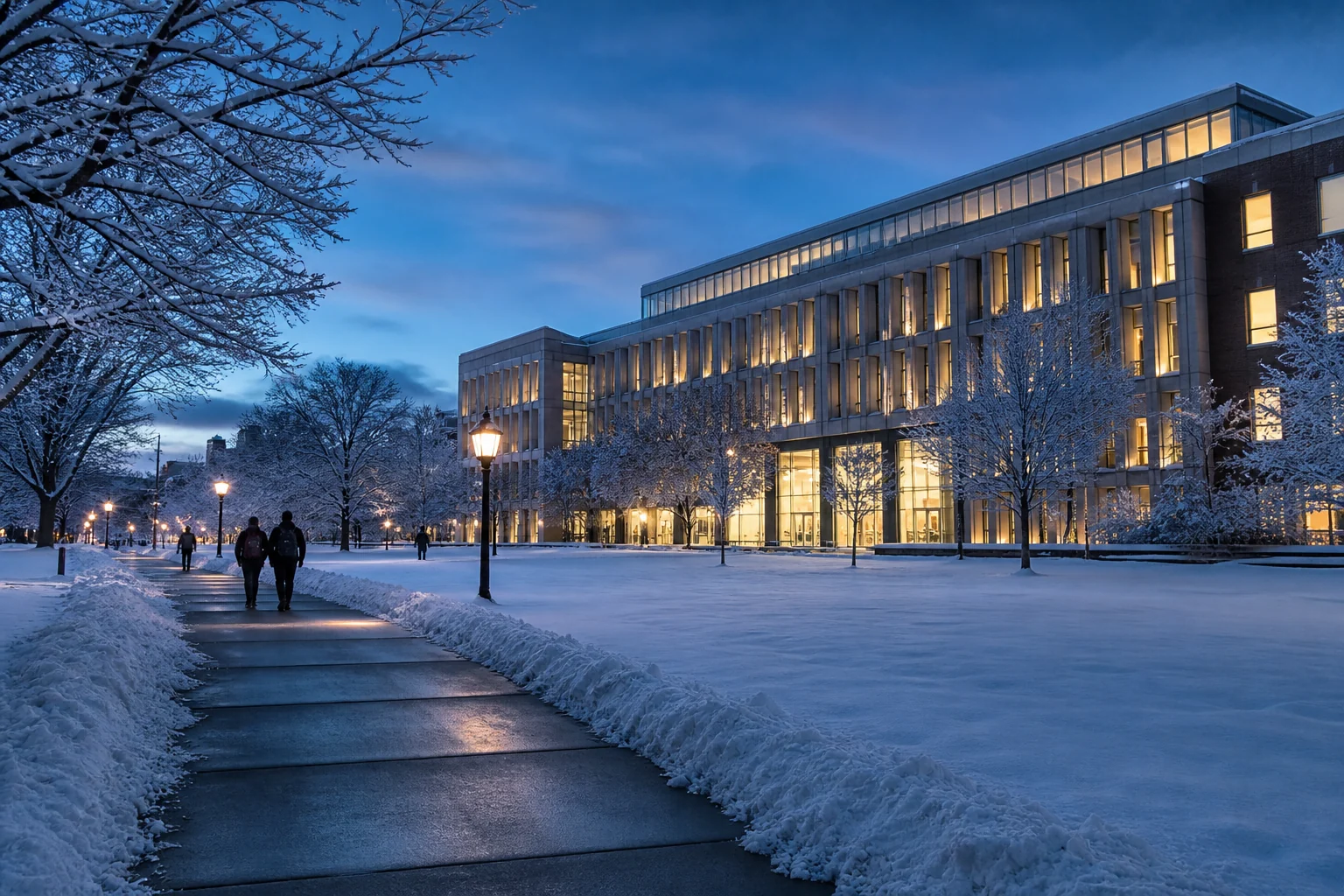
A college snow day calculator should answer a narrower question than a general forecast: do the expected snow, ice, cold, wind and timing create meaningful pressure on campus operations? This page starts with live forecast data and selects College in the model, but the institution's own notice is always final.
How to check a college snow-day chance
- Enter the city, state or province, or postal code nearest the campus.
- Keep College selected, then choose the area and the campus's usual winter-weather tendency.
- Review tomorrow first, then compare later dates for planning rather than certainty.
- Read the six factor scores and storm-timing windows—not only the percentage.
- Confirm the final status on the university's official emergency-alert or operating-status page.
The forecast comes from Open-Meteo's documented forecast API. For supported U.S. locations, active National Weather Service winter alerts appear beside the result as separate official context. The alert does not secretly change the score.
Why college closures differ from K–12 snow days
A university may have residential students, commuters, campus shuttles, laboratories and round-the-clock facilities in the same system. One institution may cancel in-person classes while keeping housing and essential services open; another may delay its start. That is why this page uses a lower general school-level sensitivity than the Elementary setting and calls the output a planning estimate rather than a prediction of a specific announcement.
Choose the area type that best describes the routes people use to reach campus. A downtown campus may depend heavily on transit and treated streets, while a rural college may have longer drives and exposed roads. The setting is broad context, not a live measurement of every commute. See the complete six-factor methodology for the exact weights.
Read the timing before the total
Snow ending well before the morning commute creates a different operations problem from the same total falling during arrival time. The result separates the previous evening, overnight, morning travel window and school hours. Use that timing to plan transportation and remote options, then review the official campus message. The guide to the best times to recheck a snow-day forecast explains why an evening look and an early-morning refresh serve different purposes.
What the estimate cannot know
- whether a particular campus road, lot or walkway has been cleared;
- power, heat or building-access problems;
- faculty, staff, shuttle or transit availability;
- whether classes move online instead of being canceled;
- the institution's final human decision.
Best use: prepare from the estimate, but follow the campus emergency-alert system for the actual decision. Never infer that travel is safe from a low percentage.
Read the accuracy and limitations statement and the guide to remote learning during snow days for the two most common gaps between a weather estimate and what students actually experience.
Primary weather sources
Forecast variables: Open-Meteo Forecast API. U.S. alert definitions and safety context: National Weather Service winter safety.